
Here’s a thing that happened to us recently. We were running a training session for a client’s internal marketing team in Powai — a reasonably sharp group of people. We asked the room: ‘Has anyone here Googled something in the last week and NOT scrolled past the first thing that appeared?’
Out of twelve people, two raised their hands.
That’s the reality of search behaviour in 2026. The first thing that appears — increasingly an AI-generated summary, a featured snippet, or a voice search result — is the answer. Everything below it exists in a different universe.
This is why Answer Engine Optimisation exists. And this is why most Indian brands are leaving enormous visibility on the table by ignoring it.
AEO vs SEO — The Actual Difference
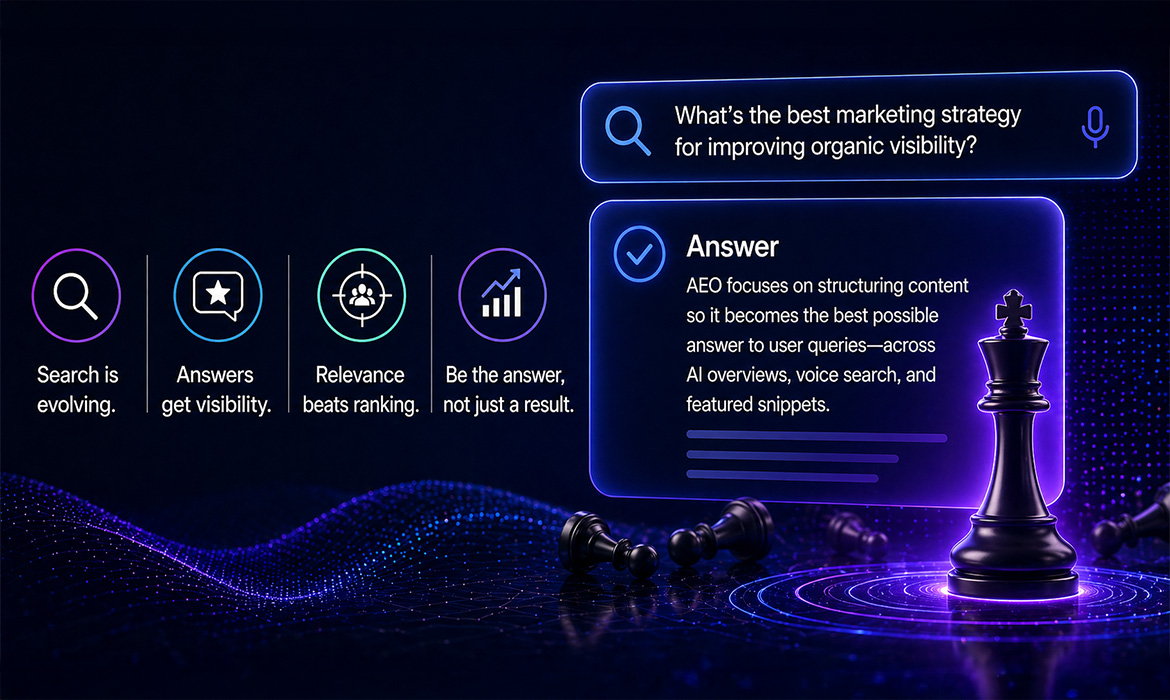
Traditional SEO is a ranking game. You want to be positioned on page one. AEO is a citation game. You want your content to be the source that answers a question — ideally in Google’s AI Overview or a featured snippet, ideally via voice.
The user experience is completely different. In SEO, a user sees a list of results and chooses. In AEO, they hear or see a single answer — and they’re done. Your brand either is the answer, or it isn’t mentioned at all.
What makes AEO particularly exciting for smaller Indian brands is that it’s not dominated by big budgets. A well-structured blog post on a focused topic can outrank a brand with ten times your marketing spend, simply because the content directly and clearly answers a question their content doesn’t.
Seven AEO Moves That Work Right Now
Structure every piece of content around a real question
Use your target question as an H2 heading. Answer it directly in the first two sentences of the paragraph that follows. Then expand. This is the exact format Google’s AI Overview engine looks for when it’s deciding what to extract and display.
Mine the ‘People Also Ask’ section religiously
Every Google SERP now shows a People Also Ask section with questions real users are typing. These are golden AEO targets. Write a dedicated section in your content that answers each of these questions — clearly, briefly, and with a specific answer rather than a vague explanation.
Add FAQ schema to your key pages
This is a technical implementation that most Indian brand websites still haven’t done. FAQ schema markup tells Google’s crawlers that your page contains structured question-and-answer content, which makes it significantly more likely to appear in AI Overviews and voice results. One afternoon of implementation work, years of ongoing benefit.
Go long-tail and conversational with your keywords
Voice search queries don’t sound like typed queries. Nobody says ‘SEO agency Mumbai cost’ to their phone. They say ‘how much does it cost to hire an SEO agency in Mumbai?’ Your content needs to include both versions — but the conversational version is what earns AEO placements.
Use numbered lists and clear definitions
AI Overview engines extract numbered steps and clean definitions at a far higher rate than dense paragraph content. If you’re writing a how-to, use numbered steps. If you’re defining something, start with a one-sentence definition before you elaborate.
Build topical depth, not just breadth
A website with thirty focused, well-researched articles on digital marketing will earn AEO placements in that category far more reliably than a website with three. The algorithm treats comprehensive topic coverage as a credibility signal.
Win your local AEO territory
For Mumbai businesses specifically, local AEO is almost completely uncontested territory. Queries like ‘best marketing agency in Andheri’ or ‘how do I find a reliable accountant in Bandra’ are triggering featured snippets that almost no local businesses have optimised for. This is genuinely low-hanging fruit.

