
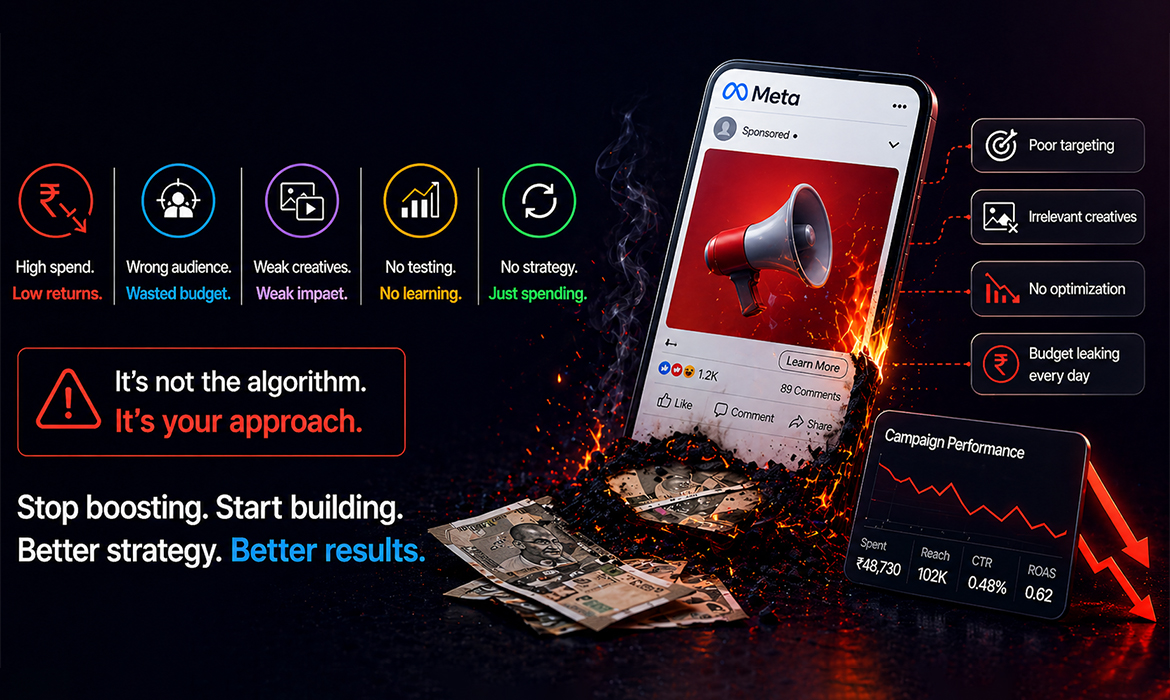
We had a client come to us last quarter — a skincare brand from Lower Parel — with a straightforward complaint. They’d spent ₹4 lakhs on Meta ads in three months and could trace exactly ₹90,000 in revenue back to those campaigns. Their previous agency had called this ‘brand building.’
It wasn’t brand building. It was wasted money with a polite explanation attached.
And they’re not alone. Indian brand after Indian brand is running Meta campaigns in 2026 with 2021 strategies, wondering why performance has fallen off. The platform has fundamentally changed. The playbook hasn’t.
Here’s the honest diagnosis.
Problem 1: You're Still Targeting Like It's 2021
The iOS 14 privacy changes didn’t just shrink Meta’s data pool — they changed how the algorithm works. Today, detailed interest targeting built from manually selected audience segments actively fights the algorithm rather than working with it. Meta’s own data shows broad targeting with Advantage+ audiences now consistently outperforms narrow interest targeting.
But we still see Indian brands running campaigns targeting ‘people interested in skincare who are 25–34, female, live in Mumbai, have recently purchased from competitors.’ That level of specificity is a constraint, not an advantage. Let the AI do what it’s good at.
Problem 2: Your Creative Is Doing Too Much Work for Too Few People
The number one driver of Meta performance in 2026 is not targeting. It’s creative. The ad itself. An ad that stops the scroll, speaks to a specific problem, and shows a believable outcome will outperform a gorgeous brand film every single time.
What we consistently see with underperforming Indian brands: one ad creative running for three months, shown to a tired audience who’s seen it forty times. Ad fatigue is real and it’s expensive. The solution isn’t complicated — it’s just unglamorous. You need to be more creative, tested more often, and kill faster when it stops working.
- Five distinct creative angles minimum per campaign
- Reels format consistently outperforms static for most Indian product categories
- Real people, real results, real language — not polished stock imagery
- Test hooks aggressively — the first 1.5 seconds determine 80% of your results
Problem 3: The Landing Page Is Undoing Everything
We’ve seen ads with 4% click-through rates driving to landing pages that load in nine seconds on mobile. With 78% of India’s digital ad spend consumed on mobile, this is a catastrophic mismatch. The ad earns the click. The landing page loses the sale.
Dedicated landing pages — not homepages, not general product pages — built specifically for each campaign message, loading fast, with a clear single CTA. This one change alone has moved ROAS from 1.8 to 4.2 for clients we’ve worked with. It’s not glamorous work. But it’s where the money is.
Problem 4: You're Optimising for the Wrong Thing
If your campaign is optimising for link clicks, you’re essentially telling Meta’s algorithm to find you people who click links — not people who buy things. In 2026, you need to be optimising for purchase events, lead events, or add-to-cart events. And for that to work, your Meta Pixel and Conversions API need to be set up correctly.
This sounds technical. It is. But a correctly implemented conversion event tracking setup is the single most important infrastructure investment a performance-focused brand can make.
Problem 5: There's No Retargeting Funnel
This is the most common and most expensive gap we see. Brands run acquisition campaigns to cold audiences, some of whom visit the website but don’t convert — and then those warm prospects are never spoken to again. Indian consumers typically need 3–5 touchpoints before a considered purchase. If you’re not retargeting, you’re paying to warm up leads for your competitors to close.
What a Properly Built Campaign Looks Like
Top of funnel: broad Advantage+ targeting, Reels-first creative, optimised for add-to-cart. Middle of funnel: social proof content served to warm audiences — testimonials, results, comparisons. Bottom of funnel: specific offer or urgency message to cart abandoners and site visitors. Each stage talking to a different mindset, with different creative, different messaging, different CTA.

