
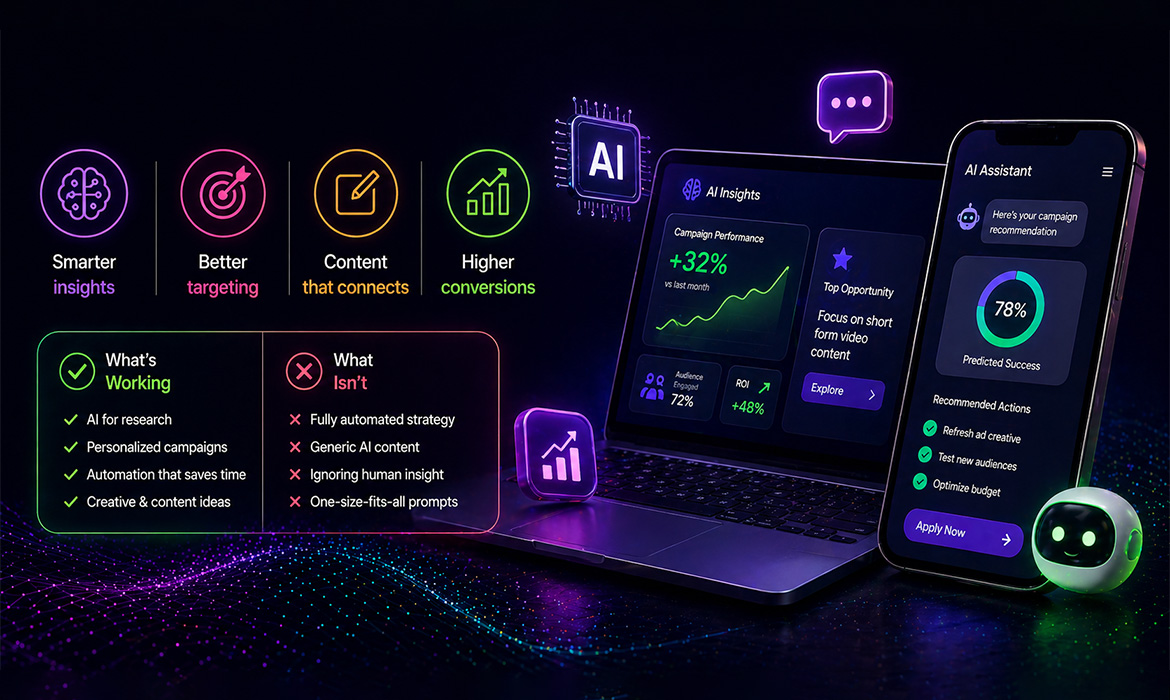
We’re going to start with the thing nobody in marketing wants to say out loud: most AI-generated content is immediately obvious to anyone who reads a lot.
It has a particular rhythm. Sentences of similar length. An over-reliance on certain phrases (‘delve into,’ ‘leverage,’ ‘in today’s fast-paced landscape’). A tendency to start paragraphs with a broad statement and then illustrate it with an example that’s always vaguely constructed but never specific.
Indian audiences — especially in B2B — are increasingly noticing. And noticing produces a specific reaction: they trust you less.
So let’s have an honest conversation about where AI is genuinely helping marketing teams in India, and where it’s quietly creating problems nobody’s talking about.
Where AI Is Genuinely Making a Difference
Volume tasks that don’t require cultural nuance
First drafts of product descriptions. Meta ad headline variations. Email subject line testing. Social caption brainstorming. For these tasks, AI is legitimately useful — it produces workable raw material faster than any human, which frees the human to do the harder job of making it actually good.
The brands using AI well are treating it as a very fast research assistant and first-drafter, not as a writer. The output always goes through a human who adds specificity, personality, and the kind of cultural texture that Indian content needs to resonate.
Ad creative optimisation
Meta’s own AI — Advantage+ Creative and the automated creative variations tools — is genuinely excellent. It can produce dozens of headline and description combinations and automatically serve the best-performing variant to each user segment. This is not something a human analyst could do manually at the same speed or accuracy. Use it.
Predictive budget allocation
Google’s Performance Max and similar tools use AI to allocate budget across formats, placements, and audiences in real time based on conversion probability. For brands that have set up proper conversion tracking, this level of automated optimisation consistently outperforms manually managed campaigns.
Customer service and lead qualification
WhatsApp chatbots that qualify leads before they reach a salesperson, handle FAQs overnight, and route urgent queries to the right person. For Mumbai SMBs dealing with high inbound volumes and limited team bandwidth, this is a genuine operational improvement. Not glamorous. Very useful.
Where AI Is Creating Problems
Generic content at scale
The risk isn’t that AI produces bad content — it’s that it produces average content efficiently. An average Instagram caption, an average blog post, an average ad. In India’s increasingly crowded digital space, average doesn’t cut through. Brands producing AI content at volume without proper editorial oversight are slowly diluting the thing that makes audiences follow them in the first place: a distinctive voice.
Cultural tone-deafness
AI tools trained predominantly on English-language Western internet data produce content that often misses Indian cultural references, idioms, and the particular warmth that Indian audiences expect from brands they love. A Diwali campaign copy written entirely by AI without Indian editorial oversight will feel like it was written by someone who has read about Diwali but never celebrated it. Audiences notice.
The homogenisation problem
If every brand in a category is using the same AI tools with similar prompts, the content starts to converge. Same structures, same angles, same examples. This is already visible on LinkedIn, where AI-generated thought leadership has made the feed feel remarkably uniform. Distinctiveness — genuine point of view, real personality — has become more valuable precisely because AI has made generic content cheaper to produce.
Use AI to do more of what already works. Build your strategy, your voice, your perspective with humans. Then use AI to scale the execution. That sequence matters. |

